 ar.io Documentation
Observer Selection
Epochs and Selection Timeline
The ar.io network operates in epochs, during which the observer selection and evaluation process takes place. At the start of each epoch:
- Observers are selected to monitor the network
- Prescribed ArNS names are chosen for all observers to test
- Observers may evaluate additional names or criteria as defined by the current observation process
This creates a consistent evaluation framework where all observers test the same baseline names while leaving room for the observation process to evolve over time.
Selection Process
Gateways are selected as observers using weighted random selection. The process combines randomness with gateway-specific weights so observer duties are unpredictable, but still influenced by stake, tenure, and historical performance.
The entropy provides cryptographic randomness for selecting:
- Observer Gateways: Gateways chosen to perform observations
- Prescribed ArNS Names: Common names all observers must evaluate
This approach prevents manipulation while maintaining weighted probabilities based on gateway performance and commitment.
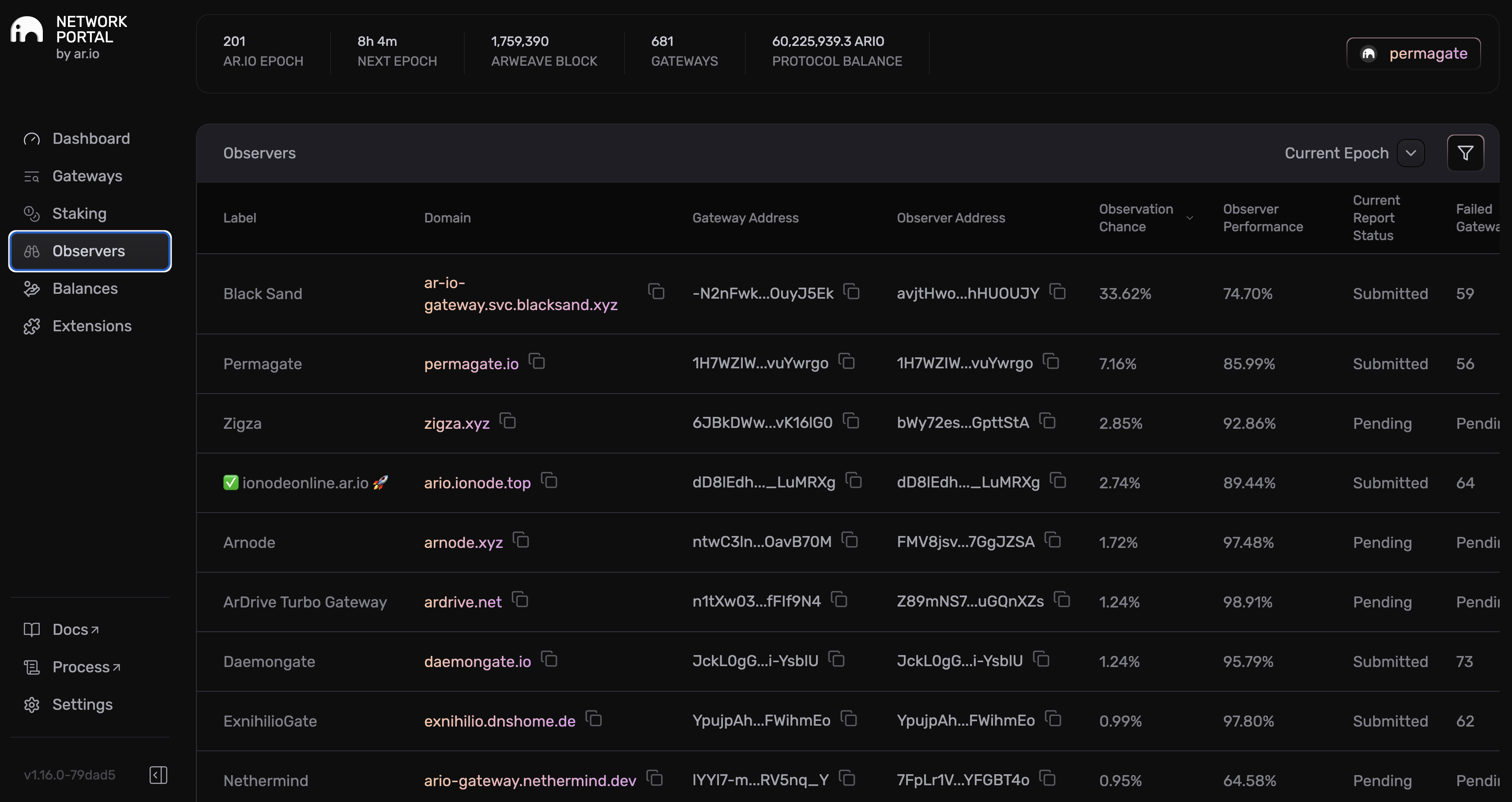
gateways.ar.io/#/observers
shows the current epoch prescribed observers and arns names, as well as their submission status
Weighted Selection Criteria
Observer selection is based on normalized composite weights that combine multiple performance and commitment factors. These weights determine each gateway's probability of being selected as an observer for the epoch.
The selection considers four key factors that are multiplied together to create a composite weight (CW):
- Stake Weight (SW): Financial commitment to the network
- Tenure Weight (TW): Length of network participation
- Gateway Performance Ratio Weight (GPRW): Historical gateway performance
- Observer Performance Ratio Weight (OPRW): Historical observer performance
These weights are then normalized across all eligible gateways to create selection probabilities. For more on how performance affects those weights, see Performance Evaluation.
Random Selection
The selection process maps random values onto normalized gateway weight ranges. Gateways with higher weights have proportionally better chances of selection, while randomness prevents predictable or easily manipulated assignments.
Fairness and Meritocracy
This system ensures:
- Meritocratic Selection: Higher-performing gateways have better selection odds
- Fair Opportunity: All gateways maintain non-zero selection probability
- Tamper Resistance: Entropy prevents predictable observer assignment
- Consistent Standards: Prescribed names create common evaluation baseline
The selection is saved in the contract state at epoch start to ensure that activities during the epoch do not affect selection or reward distribution.
Next Steps
Ready to understand how performance is evaluated? Learn about Performance Evaluation to see how gateways are scored, or explore Reward Distribution to understand how rewards are calculated and distributed.
How is this guide?