 ar.io Documentation
Gateway Registry
Overview
The Gateway Address Registry (GAR) is the public registry of ar.io gateways. It records which gateways have joined the network, how they can be reached, and the metadata applications need to discover and evaluate them.
Gateway registry state is maintained by the ar.io Solana programs. Registered gateways are identified by Solana addresses and publish service information such as hostname, protocol settings, staking state, and operator-provided metadata.
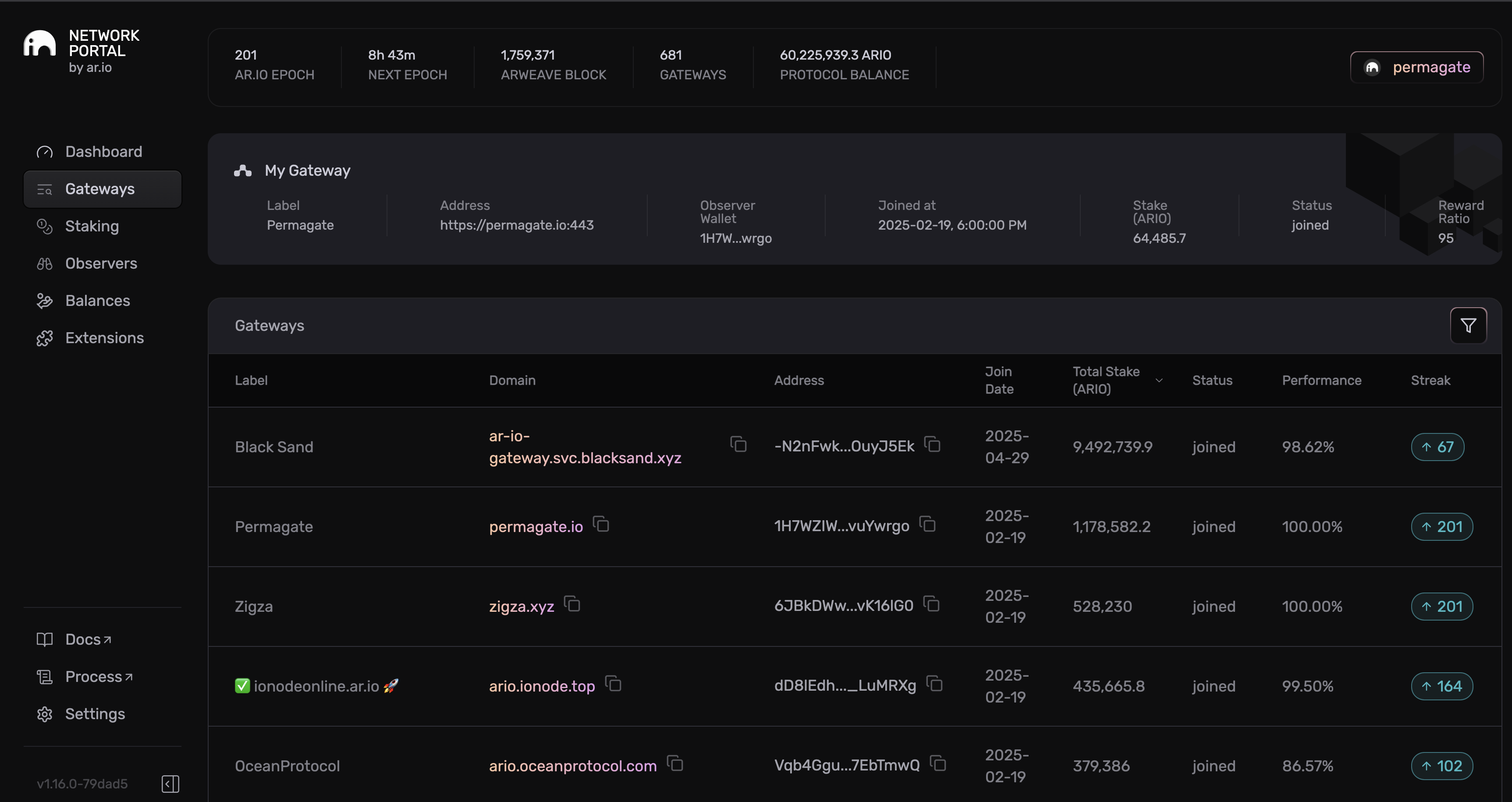
The gateways.ar.io portal displays gateways currently in the network, including stake, performance, and operational metadata.
Joining the Registry
To join the ar.io network, a gateway operator registers their gateway and locks ARIO as operator stake. Registration connects the gateway's public endpoint, operator address, observer address, and service metadata to the onchain registry.
Once registered, a gateway can become eligible for network incentives, delegation, and observation through OIP. Gateway operators also need enough SOL to pay Solana transaction fees for network interactions.
The registry has a maximum capacity of 3,000 gateways. Each gateway requires a 20,000 ARIO minimum network-join stake, and each gateway can have up to 10,000 unique delegated stakers.
Leaving the Registry
A registered gateway is always in one of three states: joined, leaving, or gone.
A gateway operator can leave voluntarily, and a gateway removed through pruning leaves the same way:
- Leaving: The gateway stops being eligible for new rewards and enters a leave window of at least 90 days, during which any delegated stake on it still has to be withdrawn.
- Gone: Once the leave window has expired and all delegated stake has been claimed, a permissionless instruction closes the gateway's registry entry and frees its slot. A gone gateway has no registry entry left; its operator has to register again to rejoin.
What the Registry Enables
Discovery
Apps, users, and other gateways can use the registry to find gateways by endpoint, service metadata, stake, observed performance, and supported capabilities.
Incentive Participation
The registry connects gateway identity to staking, delegated stake, performance history, and reward eligibility. OIP uses this information to evaluate gateways and distribute rewards.
Network Transparency
Gateway information is publicly visible through Solana state and network tooling such as gateways.ar.io. This makes participation, performance, and configuration easier to inspect.
Operator Choice
Gateways can specialize. Some may focus on fast public access, some on indexing, some on private infrastructure, some on paid access, and some on specific moderation or compliance policies.
Relationship to OIP
The registry is the set of gateways that OIP can observe and evaluate. Registered gateways are periodically checked for availability, correctness, and ArNS resolution behavior. Reliable gateways can earn rewards, while gateways that repeatedly fail can lose eligibility and eventually be removed through pruning.
Recap
- The Gateway Address Registry is the public source of network gateway metadata.
- Gateways join by registering service details and locking operator stake.
- Registered gateways can participate in OIP, receive delegations, and become eligible for rewards.
- Apps can use registry data to discover, filter, and route through gateways.
- Poorly performing gateways can be pruned from the network after sustained failure.
- A gateway moves from joined to leaving to gone as it exits the registry, freeing its slot once it is gone.
Explore the Gateway Ecosystem
Join the Network
Learn how to register your gateway and join ar.io
Delegate Stake
Participate in the network by delegating stake to existing gateways
Observer Protocol
Understand how the network monitors gateway performance and quality
Gateway Configuration
Learn about gateway settings, optimization, and operations
How is this guide?